
Feel the Funk
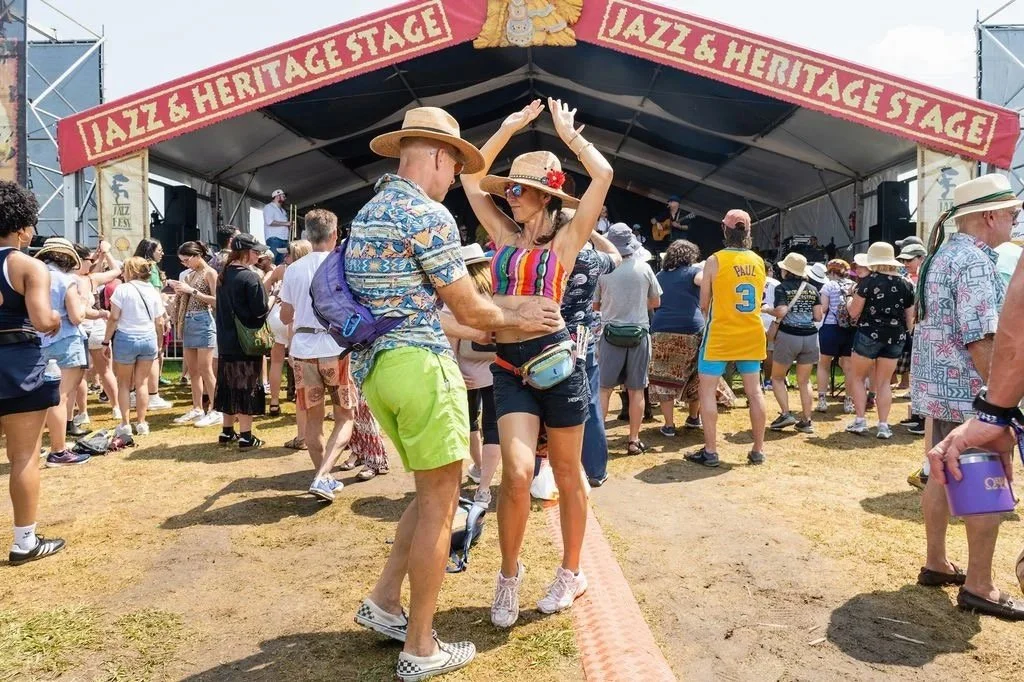
Funk music and the ADHD brain share the same misunderstood genius: a rhythm that doesn't follow the grid, a groove that only makes sense when you stop trying to fix it and start learning to listen.
I'm still recovering from Jazz Fest.
The music that makes me close my eyes. The music that makes my heart sing. The music that drives my body to move with rhythm, that grabs me from deep down in my soul, ancestral beats from my New Orleans and Cuban heritage coursing through my DNA.
Jazz Fest, for those who don't know, is two weeks of 24/7 live music in the city of New Orleans. I happen to live a few blocks from the festival grounds. Twelve stages. Eight days. All day, followed by porch concerts in the neighborhood, street performers, and night shows at all the clubs around town. The city is invaded by musicians and music lovers, and not only is the scent of jasmine and magnolia in the air, the rhythm is something we can almost smell. When the wind blows in the right direction, I can hear it from my terrace.
People come from all over the world. Locals seize the opportunity to catch out-of-town performers, or to see a favorite local musician at a daytime show, before their usual bedtime. A common conversation all week is about choices. Who are you going to see? Are you going to plant yourself in front of one stage, or run from one to the other?
On the last day, I offered to take someone's picture as they struggled with a selfie. "Who are you going to see?" he asked. "I think I'll catch part of Herbie Hancock, then get over to Mavis Staples," I said. These are living legends, and I'm so lucky to have them here. He smiled. "I'm going to see Trombone Shorty." "I get to see him often," I replied. "I live here." "Oh, you're so lucky," he said. Indeed. Yes, I am.
It's a particular pleasure to witness the appreciation of the New Orleans sound from someone experiencing it for the first time, especially our funk scene. While I didn't get to see Trombone Shorty that day, I did catch several other shows at the Fest, all of them characterized by our signature rhythm: Dumpstaphunk, Big Sam's Funky Nation, Dragon Smoke, Galactic, and the legendary George Porter Jr. of the Meters.
Days and nights at Jazz Fest got me thinking about funk. What is it, exactly? Why do some people love it and some people don't? Some people don't get it at all. Some people feel it in their bones. It's a below-the-waist type of thing, and some people simply can't follow it, preferring the more classical, melodic line. Then there's the word itself.
Outside of the music world, "funk" has a decidedly negative connotation. According to Merriam-Webster, it primarily refers to a strong, bad smell, or a depressed, cowardly state of mind, as in "I'm in a funk." Something funky has an offensive odor. Synonyms include stench, slump, despondency. As a verb, it means to shrink back in fear.
And yet.
Funk is also a music genre born in African American communities in the 1960s, evolving from soul, jazz, R&B, and gospel. It is infectious, danceable, driven by a prominent drumbeat, a deep bassline, and percussion that lives in your chest. Guitar and horns weave in melodic and rhythmic texture, but the rhythm section is everything. James Brown, the Godfather of Soul, gave the world its clearest early expression of it. Lyrically, funk addresses social and political themes, love, empowerment, self-expression, but the real point is always the groove. The groove that moves the listener whether they want to move or not.
New Orleans added something particular to this story. Our funk is leaner, greasier, more syncopated. Its DNA was formed in Congo Square, where enslaved people preserved West African polyrhythms that eventually became the second-line beat of the brass band parade, the heartbeat of this city. In the 1940s and 50s, Professor Longhair blended boogie-woogie with Afro-Cuban rumba rhythms, creating a syncopated piano style that still defines the New Orleans sound. Earl Palmer, one of the great session drummers, began "funking up" standard R&B beats for artists like Fats Domino, quietly laying the groundwork for everything that followed.
In the 1960s and 70s, the Meters arrived and changed the architecture of rhythm. Four musicians playing with almost frightening restraint, building a groove that felt like weather. Their stripped-down instrumental hits, "Cissy Strut" is the canonical example, emphasized what musicians call the pocket: that locked-in, breathing place where rhythm becomes physical. Allen Toussaint refined and elevated the sound, using the Meters as his house band for legendary recordings by Lee Dorsey and Dr. John. Mardi Gras Indian funk emerged in the 1970s, weaving traditional masking chants into electrified grooves. The Neville Brothers carried the second-line sound to international audiences. And today, Trombone Shorty, Jon Batiste, and Dumpstaphunk, led by Ivan Neville, keeping the family legacy very much alive, continue pushing the tradition forward.
The groove, as they say, must go on.
I am often in a funk the days after Mardi Gras, or when I return from vacation. When I pass my son's gym bag, I can clearly smell the funk emanating from within. After a few workouts, my laundry basket gets pretty funky. And a really good aged cheese? Extraordinarily funky. The kind that clears a room before it delights one.
It's not for everyone. But those who appreciate it really get it.
Why is it that something so displeasing to most can be so wonderful at the same time? Here in New Orleans, funk is our normal. Dancing is inevitable. Anything else is just plain boring. It may be pretty, it may even be sad, but it won't drive your lower half to bounce.
I remember when my dad brought home a jar of precious kimchi, gifted by a client. Eeeuuw, Daddy, please put that stinky stuff away. We teased him every time we opened the fridge. We eventually learned to love it, as my dad shared what he had discovered about beautiful Korean culture during his business travels. What once made us wrinkle our noses became something we craved.
Some things have to be understood before they can be loved.
When I returned to my office for client sessions, refreshed, recharged, and re-energized by the total immersion of music and dancing, my brain went bing. My clients, many of whom have ADHD, were like extraordinary funk musicians. Only they, or those around them, didn't yet know how to listen.
Many of my clients are neurodivergent. All of them are striving to live according to their own internal logic in a world built for a different operating system. Some of their traits may be seen as challenges by most, but serve them as strengths when properly appreciated. "Impulsivity" becomes "the ability to take calculated risks." "Too sensitive" becomes "exceptionally intuitive." "Daydreamer" becomes "extraordinarily imaginative."
Clients come to me saying, "Please make me more productive." (Everyone else can do it, why can't I? I took all of their advice and none of it works for me.) Some say, "Nobody likes me the way I am, so please change me." (Help me be someone else, so I can finally please the people around me.)
When I hear this, I think: you are a funky musician sitting in a classical conservatory, wondering why you can't seem to play the right notes. You are aged Roquefort in a box of Velveeta, wondering why no one seems to want you at the party.
Maybe the problem isn't the funk. Maybe nobody taught you, or the people around you, how to listen for it.
Take Jenn. Her mind moves at warp speed. She gets bored easily at events where small talk is required, especially with the parents of her children's classmates. Her brain doesn't follow the linear conversation. When asked how she knew something, she felt threatened, attacked, misunderstood. She couldn't explain why. She just knew. She felt it. Eventually she came to understand and trust her intuition over logic. She could spot an opportunity, feel whether it was right, and move on it, without being able to explain why, and without needing to. With that newfound trust, she jumped on a risky real estate opportunity and walked away winning.
Jenn didn't need to be fixed. She needed to learn how to listen to herself.
Why is funk so difficult for so many people? Because it prioritizes rhythm over melody, demanding a mindset shift that feels counterintuitive to anyone trained in classical or rock music. While most genres focus on harmony or complex chord changes, funk is the only music where the closer you are to the drums, the better everything sounds.
It starts with something musicians call The One. In most popular music, the emphasis falls on beats two and four, the backbeat. Funk flips this, anchoring everything on the first beat of every measure. That heavy downbeat acts as gravity, letting everything else float and push around it. If you're not used to it, it can feel destabilizing, like the floor has shifted beneath you.
Then there is what players describe as precise sloppiness. True funk is simultaneously metronomic and loose. Musicians intentionally place notes a fraction of a second behind the beat, a feel that many classically trained players spend years trying to replicate and never quite find. It requires playing simple parts, sometimes a single note, for hours, in service of the groove. Many gifted musicians struggle to give their ego a rest long enough to stay in the pocket rather than show off what their hands can do.
And then there is this: the spaces between the notes matter as much as the notes themselves. Silence is as much a part of the groove as sound. You have to learn to stop listening to the instruments and start listening to the holes they leave behind. That is where the stink lives.
Sound familiar?
The ADHD brain often emphasizes what is not mainstream. It hyperfocuses on its own groove. What others perceive as sloppiness is frequently intentional, and core to what makes it extraordinary. The dirty sound isn't carelessness. It's micro-timing. It's a master chef using a pungent fermented ingredient, balancing what an untrained palate might dismiss as off into something far more complex and satisfying than anything purely sweet could ever be.
Funk is not a head or heart experience. It is a waist-down experience. Its goal is not a pretty melody you hum on the way home. It is a physical response, friction that makes the body move. Too clean, and it loses its gravity. This is precisely what we mean here in New Orleans when we say, I feel the funk.
In a world of perfectly quantized, computer-generated beats, funk is a celebration of human imperfection. That greasy New Orleans feel is the sound of human beings breathing together. It doesn't follow a grid. It follows a pulse. There is no rubric for it. It lives and breathes.
The highest compliment in the funk world is the stink face. When a groove is so deep, so perfectly in the pocket, the listener looks like they've just smelled something bad. That's the signal. That's how you know it's working. This is what I love most about watching George Porter Jr. of the Meters play. Watch the waggle of his head when he is deep in it, nose wrinkling, eyes closing. The stink face at its finest. A master at work.
I didn't learn to appreciate my own funk at a concert. I learned it in the muddy depths of the forest.
When I first began my own ADHD coaching journey, perfectionism had its hands around everything. Not just my work, but my parenting. The other moms threw birthday parties straight out of Pinterest, with elaborate cakes, fancy venues, and party favors that rivaled the gifts brought. It felt like a competition with no finish line.
By the time my son's birthday rolled around, I leaned into doing it my way. We both loved the outdoors. We loved camping, Cub Scouts, getting dirty in the woods. So that's what we did. We built a scavenger hunt in the Couterie Forest. One mom showed up in heels that sank straight into the mud. The kids screamed and squealed and ran wild through the trees. They chased each other with sticks, fell into lagoons, and emerged covered in leaves and muck, absolutely beside themselves with joy. The forest gave them something rare. Permission to be exactly, wildly, unapologetically themselves. The noise was glorious. Several parents stood at the edges looking quietly horrified. The kids were ecstatic. My son was ecstatic. I was so happy.
At the end of the party, one by one, the kids came up to thank me for the best party ever.
Not everyone appreciated it. I was more than okay with that.
That was the day I stopped apologizing for the funk.
Sometimes it takes another person to help us learn how to listen to what is uniquely ours. A coach can reflect back what they hear as we verbally process, with open curiosity, in a safe and non-judgmental space. Together we can explore how our minds actually operate, not how we've been told they should.
When we take the time to understand how our brains work, why they do what they do, and why that might be a genuinely good thing, everything shifts. We can invite the right people to play with us. We can identify the environments where we thrive. We can advocate for ourselves, clearly and without apology. We can quiet the inner critic that has been judging us against a set of definitions that were never ours to begin with. We can celebrate doing our own thing, and surround ourselves with people who appreciate us for exactly who we are.
What is uniquely ours may be precisely what someone else has been missing. It may not be for everyone. That's okay.
Please don't make us sit in endless meetings, a slow death by PowerPoint. Please intellectually stimulate our brains with challenging questions and bold explorations. Please infuse our connections with play and experimentation. Please be open to novelty and imagination. Please give us space and freedom to be ourselves. Let us feel the funk. Let us move the way we feel.
Invite us to dance.
The Meters said it best in "Funkify Your Life." Go find it. Put it on. Turn it up until you feel it below the waist. That's the assignment.
When in your life have you felt most like yourself, most in your natural groove?
What "funky" quality of yours has been described as a flaw that you secretly suspect is actually a strength?
What would it look like to stop trying to play mainstream music and start building a band that plays your kind of sound?
Who in your life genuinely hears you, not just tolerates you, but appreciates the way you operate?
What does your stink face look like?
"Feel the Funk" is a blog post by Adela Baker, ADHD coach and founder of Mind Coach, LLC in New Orleans. Drawing on her experience at Jazz Fest 2026, Adela uses New Orleans funk music as a metaphor for the neurodivergent mind, exploring why traits like hyperfocus, intuition, and nonlinear thinking are not deficits to be corrected but strengths to be understood and celebrated. The post covers the history and characteristics of funk music, the ADHD parallels in how funk is misunderstood, and the coaching process of helping clients learn to hear and appreciate their own unique groove. Written for high-achieving neurodivergent professionals, Turbo Thinkers®, navigating a mainstream world.
Zest, Adela
For more journals featuring communal groove, check out "Bubbles & Belonging: The Science of Collective Effervescence"
For more journals featuring primal intelligence, check out "Human or Bot? It Matters a Lot! A Tale of Multiple Intelligentsias"
For more journals featuring Stop Fixing, Start Listening, check out "The Gift of Not Knowing: Why Beginner’s Mind Is a Turbo Thinker’s Secret Weapon"