
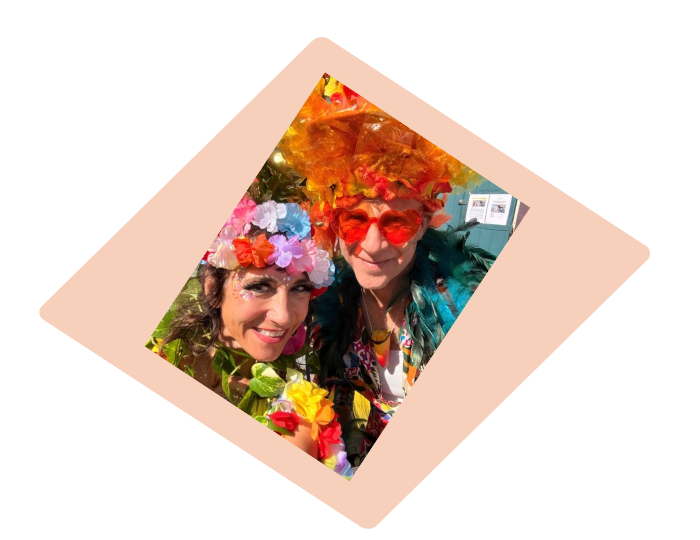
This article explores the phenomenon of collective effervescence, the shared energy we experience in communal rituals, celebrations, and gatherings, through the lens of New Orleans Mardi Gras. Drawing on the research of sociologist Emile Durkheim and philosopher Mikhail Bakhtin, as well as personal experience and the latest well-being research, it connects the science of belonging to the lived challenges of Turbo Thinkers: isolation, depletion, distraction, and hustle culture. It offers practical pathways to create your own collective effervescence, no parade route required.
Lent Has Begun. I’m Back at My Desk.
On my first days returning from Mardi Gras break, I found myself feeling a little defensive. How was Mardi Gras? my out-of-state clients asked, with a mischievous grin and a wink baked right into their tone. My local clients, it should be noted, had already canceled their Wednesday and Thursday sessions. No explanation needed. Ash Wednesday is a Holy Day of Obligation. Here in New Orleans, Mardi Gras and the days leading up to it are tied directly to the Catholic liturgical calendar. Carnival, from the Latin carne vale, meaning farewell to meat, is the final feast before the Lenten fast. Businesses and schools close. Participating in Carnival is, for many of us, practicing our faith. The post-carnival re-entry is understood as its own sacred rite: time to transition, to clean the house, to stock the fridge with healthy food before the season of reflection begins.
My costume closet had vomited a giant pile of wigs, tulle, feathers, and sequins onto the floor. My craft corner had a trail of glue gun cables, fairy light wires, and beads. Glitter bombs had exploded throughout the house. The floors and counters were sticky. For those outside our orbit, there is a persistent image of Mardi Gras as a four-day binge-drinking spectacular of debauchery, where people expose their tatas for shiny plastic beads. And sure, for some visitors, that may be the story they tell. But it is a far cry from the experience of those of us who call this city home.
When people ask how my Mardi Gras was, my first answer is simple: It was magical. And then I pause. Because that word, magical, is doing a lot of work. What is it, exactly, that makes it feel that way? And why does it matter that we name it?
The Carnivalesque: What Outsiders Are Missing
I am, by training and by temperament, a curious person. So when I found myself feeling defensive about my time off, because in a hustle-first culture, several days of what looks like a party can feel like a guilty pleasure rather than what it actually is, I decided to do some research.
My Krewe captain introduced me to Mikhail Bakhtin, a Russian philosopher whose work explored the profound significance of Carnival to Western culture and the human spirit. Bakhtin identified what he called the Carnivalesque: a specific set of principles that define why carnival is so much more than entertainment.
The carnival is alternative, existing outside and in opposition to official culture and the serious structures of power and hierarchy. It is participatory, with no border between audience and performance; everyone is the carnival. It is ambivalent, holding both the beautiful and the grotesque, the serious and the absurd, without forcing resolution. It is utopian, liberating the imagination from the conventional and revealing the possibility of something different. It is anarchic, because no single authority can control it; it is the sum of its people. And it is unfinished, always in process, always becoming.
If you are a Turbo Thinker, it probably sounds a little like home.
In New Orleans, these principles are not abstract philosophy. They are alive in the streets. The costumes range from the exquisitely constructed to the magnificently satirical. The colors are dazzling, but some are intentionally jarring, a visual argument, not just an aesthetic one. There is sequin and satin and glitter and feather and tulle, yes, but also NICE agents roaming the route, shouting, “No mean people allowed!” This year the themes were especially cheerful: clowns, flowers, fantastical creatures, nature, love. As if we collectively decided that what we needed most was beauty and joy.
Mardi Gras magic also emerges because it is interactive. We are not watching. We are parading and dancing and moving through the city on foot and by bike. We are immersed. We are not documenting; we are living. We are leaning into full expression, full dancing, declarations of exuberance, embraces of joy. What might have been a casual acquaintance last week has become your closest friend by Tuesday afternoon. Race, class, and gender divides disappear as we become one. We share food, drinks, party favors, and throws. We compliment each other’s creativity. No one is a stranger. Everyone is welcome to the party. We celebrate life.
The Season, the Buildup, and the Magnificent Release
Collective effervescence, the electric shared energy we feel when we celebrate together, is not a luxury or an indulgence. It is essential nourishment for the human spirit, and we have far more power to create it than we think.
What outsiders also miss is that Mardi Gras is not a single day. It is a season. We begin on January 6th, Epiphany, King’s Day, and celebrate every weekend from there. The final weekends grow more intense. The last five days, Friday through Tuesday, become a near-continuous, around-the-clock carnival. The buildup is inseparable from the magic.
This year I went in hard and fully committed: late-night balls, parties, early morning and evening parades. I ran on little sleep, exploring different neighborhoods and different friend groups and family, each celebrating in their own particular way. I created multiple costumes for the various events and had a blast in every single situation.
Mardi Gras also morphs across the stages of a life, and that is part of its genius. When my children were young, we set up a homebase: a wagon, a ladder for the kids to stand on, chairs for my parents to sit and watch from a comfortable distance, a picnic table of shared dishes. You can choose to have a home camp or be free range. I used to write my cell phone number on my son’s arm in Sharpie when he was very young, knowing he was a curious little soul who could get carried away by the music in the moment and follow the beat, or a bouncy ball, all the way down the street.
Carnival is not one thing. It is many things, at every age, for every kind of person. I like to begin Mardi Gras Day around 5am, ceremoniously putting on my costume and doing my makeup in time for the walk to Treme. This year, instead of witnessing the Skull and Bone Gang ceremony before dawn, I marched with Mondo Kayo, opening for the Zulu parade and getting the crowds dancing with tropical beats: “Carnival reminds us that life is but a mask. Seeing through these disguises is our ultimate task... joy and love are evil’s defeat.”
I met the Saint Anne parade with friends, stopped at homes in the Marigny and the French Quarter, and encountered a myriad of fantastic DJs along the way. That afternoon I joined the Krewe of St. Anne at the river, where the brass band switched from high-stepping songs to a haunting version of A Closer Walk With Thee. It is a tradition born in the 1980s when the gay community was devastated by AIDS, a ceremony where ashes of lost loved ones, mixed with glitter, are carried to the river and lovingly released. Fabric-covered rings called “crab nets” are dipped into the water and hoisted back above the crowd, raining river water as a symbol of baptism and new birth. It is, at once, the most tender and most alive thing I have ever witnessed.
Mardi Gras Day is, in the most accurate sense of the word, an orgasmic release: the magnificent culmination of weeks of anticipation and building energy, followed by an afterglow that is entirely its own. On Mardi Gras Day I logged 38,439 steps between 6am and 6pm. My cheeks hurt from smiling. My feet ached. And the glow followed. A colleague noted on Zoom days later, “I don’t know what happened to you on Mardi Gras, but it shows.” Ash Wednesday was a day of cleanup, a handful of sessions, an evening mass full of song, and seafood.
So yes. I am going to defend my time off. And I now have the research to back me up.
Collective Effervescence: Your Brain on Belonging
In my moment of defensiveness, I encountered a term with which I am now obsessed: collective effervescence.
The concept was coined by the sociologist Emile Durkheim, who used it to describe the intense, shared emotional energy, the sense of unity and transcendence, that arises when people gather together for rituals, celebrations, performances, or shared experiences. Durkheim called it a “sensation of sacredness” that elevates individuals out of the mundane. A concert where everyone sings the same lyric at the same moment. A stadium when the home team scores. A religious ceremony where the music moves through the congregation. A parade where a stranger drapes beads around your neck and says Happy Mardi Gras! like they truly mean it.
At its core, collective effervescence involves groups arriving at a shared heightened emotional state, whether joy, awe, or grief, directed toward a common experience or moment. That shared focus creates what Durkheim called the “sacred” quality, a sensation of being temporarily lifted out of ordinary life. And while the experience itself is transitory, its effects on social bonding are sustained. According to research published through the NIH, collective effervescence is a transitory state with lasting consequences. The benefits, for both the individual and the community, are substantial.
For you personally: Collective effervescence acts as genuine catharsis, an allowed chance to express ordinarily suppressed emotions and to unshackle from the straitjacket of daily life. Studies show it increases subjective well-being and life satisfaction, reduces anxiety, and has measurable psychophysiological restorative effects. It helps you, in the most clinical possible terms, clear the mind.
For your community: Collective effervescence builds what researchers call social capital, the interpersonal trust and cohesion that makes neighborhoods resilient. It transforms opposing groups into a single, more inclusive community. In New Orleans terms, it is the glue. The bonds formed in krewe culture, in second line culture, in the culture of mutual care and celebration, are the same bonds that allow a city to lock step and support each other through hurricanes and pandemics.
As a psychological safety valve: Sociologists have long described Mardi Gras as a “ritual of inversion”, a time when the world is temporarily turned upside down, when hierarchies are suspended, when the pressure cooker of ordinary life is finally allowed to release. This is not irresponsible escapism. It is, quite literally, essential community maintenance.
Caroline Thomas, a prominent Mardi Gras artist, describes it as a community fire drill: by building bonds and collaborating during the good times, New Orleanians create the social networks that allow them to survive the bad ones. The culture is the tool for survival.
Studies on synchronized movement, the kind that happens when you march with a brass band or dance in a crowd, show measurably elevated endorphin levels and increased pro-social behavior. Dancing with strangers makes you a better neighbor.
The way I see it, we are a bottle of champagne, bubbling with shared energy and life. The sparkling effervescence only exists because of the gathering. Collective effervescence supports not only the individual but the community as a whole, in a beautiful symbiotic relationship.
What I See in My Coaching Sessions
I work with Turbo Thinkers, high-achieving professionals with fast-moving, creative minds, many of whom have ADHD. And while every person I coach is beautifully distinct, I notice a consistent link between the challenges they bring to sessions and the absence of collective effervescence in their lives.
The opposite of collective effervescence, according to Durkheim, is what he called the Profane: the repetitive, utilitarian, individualistic daily grind. The relentless focus on tasks and survival, devoid of higher meaning, community electricity, or joy. Not dramatic suffering, but a quiet drying out of the soul. Researchers describe this state in three interlocking forms.
Social atomization, the sociological opposite, is the state where individuals exist as completely separate units with no meaningful connection to those around them, the Profane life focused only on personal survival and tasks.
Emotional dissonance, the psychological opposite, is the feeling of being out of sync or isolated even when others are present, physically in a room but experiencing no shared focus or warmth.
Moral fatigue, the spiritual opposite, is the depletion of emotional energy itself. Where collective effervescence provides a recharge, its absence drains us of vitality and replaces awe with cynicism.
In my sessions, this tends to surface in four distinct ways:
Isolation (“I am on my own’): Many Turbo Thinkers spend enormous energy hiding, performing, and code-switching in professional environments. The experience of being fully and freely yourself among others who celebrate you without reservation, which is exactly what carnival offers, can feel like a foreign country. And when that kind of belonging is absent, the loneliness is not just uncomfortable. Research is unambiguous: chronic social isolation is a serious health risk.
Depletion (low energy, apathy): Without the recharge that communal rituals provide, we run on fumes. The ADHD brain, which already works hard to regulate itself, is particularly vulnerable to this kind of vitality loss. We forget, in the grey season, what it felt like to be alive.
Distraction (fragmented attention, doomscrolling): One of the things I noticed most about Mardi Gras is how profoundly present everyone was. No phones. No documentation. Just full immersion in the moment. Turbo Thinkers often struggle with presence; our minds are always ten steps ahead. But collective effervescence, by its nature, demands your full attention. The shared focus is the point. It is one of the few environments where our hyperfocus becomes a superpower rather than a liability.
Utilitarianism (only the ‘Profane,’ working for a paycheck): We live in a culture that demands we justify our rest, our play, our joy. What did you accomplish this weekend? For many Turbo Thinkers, the pressure to be productive at all times has become so internalized that pleasure feels like a moral failure. But what Bakhtin understood, and what the research confirms, is that play and collective celebration are not the opposite of meaningful work. They are its replenishment. They are what make the work possible.
I am not just talking about taking a vacation. I am talking about a fundamental, recurring need in the human system for transcendence, belonging, and joy. And it is one that, for many of us, goes chronically unmet.
But Do I Have to Wait for Carnival to Return?
Lent has begun. As of today, there are over 350 days until the next Mardi Gras. Sigh. I ask this not just for myself and my local friends, but for all of you who live in places where carnival is not on the calendar, where the streets do not fill with brass bands and feathered headdresses, where there is no second line to join, no parade to run toward. Collective effervescence does not require a parade route. It requires intentionality. It requires that we take the principles seriously and build opportunities for them, in whatever form our lives and communities can hold.
Seek group movement and music. Synchronized activities are among the most reliable catalysts for collective effervescence. Community choirs, drumming circles, dance classes, even a group fitness class; anything where bodies move together to a shared rhythm mimics the neurological and social experience of a second line. We don’t have to call it a parade. We just have to show up.
Pursue serious leisure. Much of the benefit of Mardi Gras comes not from the day itself, but from the months of making that precede it: the costuming, the float-building, the practicing. Psychologists call this serious leisure, skill-based creative engagement that builds identity, community, and long-term well-being. Community theater, makerspaces, art classes, local sports leagues. The krewe is the model. The krewe is the thing.
Ritualize the ordinary. A monthly themed dinner party. A walking club that meets every Sunday morning. A neighborhood gathering that happens rain or shine. A book club that is really an excuse to see each other. The container matters less than the commitment to show up in it, together, on purpose.
Seek place-based community events. Even quiet towns may have harvest festivals, art fairs, farmers’ markets, or charity runs. These are the seeds of collective effervescence. The goal is not to find a party. It is to find a purposeful gathering, one where the shared focus, the shared energy, and the mutual delight in each other’s company can do their quiet, essential work.
For Turbo Thinkers specifically: We are wired for this. Our enthusiasm, our creativity, our deep capacity for joy and connection, these are not symptoms to be managed. They are the gifts we bring to the table. We are, by nature, carnival people. The work is not to become something we are not. It is to build more spaces where what we already are is welcome.
May the Magic Continue, Because We Are the Ones Who Make It
Ash Wednesday came and went. The craft supplies are back in their bins. The costume closet door is closed. My cheeks have stopped hurting. My feet have recovered. But I am still glowing.
And I keep thinking about what Mondo Kayo says: joy and love are evil’s defeat. In a world that offers us daily doses of tragedy and ugliness and injustice, the choice to celebrate together, to show up and be present and be joyful and be alive, is not naive. It is not irresponsible. It is one of the most subversive and sustaining things a human being can do.
Durkheim was right. Bakhtin was right. The researchers who measure endorphins and social cohesion and life satisfaction are right. And the people of New Orleans, who have known this for three hundred years, are right too.
We need each other. We need to celebrate together. We need to move our bodies in sync and dress up in absurd costumes and share food and say Happy Mardi Gras! to a stranger like we mean it, because we do.
The magic is real. And the magic is ours to make.
In collective effervescence, we overflow with life, popping with bubbles and sparkling joy. Alone, it is just a fart in the bathtub. The effervescence is in the gathering. Of course, it is now Lent. So perhaps a non-alcoholic sparkling cider will do.
✦
Questions for Reflection
When did you last feel the electricity of being part of something larger than yourself?
Where in your life do you feel most fully yourself, without apology or performance?
What communal ritual, however small, could you build or join in the next 30 days?
As a Turbo Thinker, where are your carnival people? And if you haven’t found them yet, what are you waiting for?