
Eaten By Love: Why It Feels Wrong When Things Get Easier
Reading time: About 5 minutes (967 words)
Why does it feel wrong when things finally get easier? A mother octopus who dies so her babies can eat her made me ask whether that discomfort is destiny, or a story we're free to rewrite.
It's been a few weeks, and I can still see her. Her giant googly eye, looking at me. One mother speaking to another, in a different world of mother earth. I come from the land above. She lives in the sea.
A few weeks ago, I had the good fortune of scuba diving in the northern Adriatic, twenty meters down, along a cliff wall that dropped straight into open water. On one side of me: the wall itself, an apartment building of marine life, the crevices occupied with a myriad of tenants. On the other side: the abyss. The drop, shades of blue to my left, to my right, black with no bottom in sight.
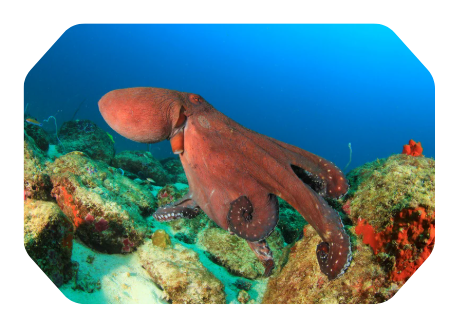
Somewhere along that wall, I found myself face-to-face with a giant mother octopus, guarding her eggs in a cave. Her tentacles moved through different hues of magenta, hot pink shading into deep purple, lined with a bright highlight stripe of orange. At first I didn't know what I was seeing. Her suckers were white. So were her eggs. So was her enormous eye, staring at me, telling me: I see you. You understand. Please don't come closer.
When we surfaced, our guide, Vlady, told me the octopus would stay there until her babies were born, and then she would die, so they could eat her. The ultimate sacrifice.
I thought about my own two decades as a parent, dedicated to nothing but my children, and it felt like nothing compared to hers. Parenting has always been the most rewarding role I've played, and the most difficult. I wondered if it feels difficult for her too. Does she even know what's waiting for her? No one could have warned her. As a hatchling, she had eaten her own mother. The species survives with generation after generation of mothers eaten by the very love they give.
Who says that we must suffer in silence for it to count? Martyrdom need not be everyone's story. We can choose to live with joy and ease. We each get to write our own story.
The octopus is an intelligent being. We say the same of ourselves. Does her intelligence include free will? Was mothering her choice? Across so many human cultures, for so many generations, motherhood has never really been framed as a choice at all. If you're born female, it's assumed: one day you'll be a mother. That's your destiny, not your decision. Did she ever hear a voice telling her she should? I wonder if an octopus has an inner critic, telling her she's lazy, she's not living up to her potential, she really should lay thousands of eggs. Who decides that? Where's the proof?
Only we get to decide what's true. Only we get to define our own core values, even when they differ from everyone else's, and that's allowed. Only we get to name our own needs and nurture our authentic selves. This can't be outsourced, not even to AI. Anything else is a kind of cognitive surrender, made of other people's thoughts and ideas. Why would we surrender our own destiny? We can't control the world around us. But we can decide where we direct our focus and our attention.
On land, we exhaust ourselves trying to impress people who may not even care, chasing scripts we never wrote, running a constant commentary in our own heads about what we should be doing differently. It can feel so urgent. Down there, it dissolves into silliness. How could it have felt so important?
I'm incredibly proud of my own children, and they didn't eat me. Maybe that's why. I want them to live according to their own values, to make choices because those choices are theirs, not because the world expects it of them. I want the same for my clients. If someone wants to give their time and energy to a passion project, such as global sustainability, rather than raising children, that's theirs to choose. Passion is what carries an idea from thought into action. For Turbo Thinkers™, igniting the passion has never been the hard part. Love, the emotion underneath the passion, is what sustains the fuel until the project is done. We shame ourselves for lacking motivation, when the real question is simpler: what actually matters to you? What ignites your fire, and how do you build space to protect it, and give yourself permission to let the rest be good enough?
That afternoon, back in my remote office, showered and dressed, I met with a client, Emily. Months ago, she had begun coaching feeling she should be more productive as she grew into a leadership role. She also felt like a hot mess at the time, trying to live up to expectations she had never actually chosen for herself. Somewhere along the way, she'd absorbed a version of "should" that was never hers to begin with. Emily told me, eventually: the funny thing is, I'm more productive than ever, because I stopped trying to be. I focused on what I loved: my friends, my relationship, my dog, my family. The rest just fell into place. It got easier to let go, to collaborate, to delegate, to give herself permission to ask for the help she needed instead of suffering in silence. She came home from a girlfriends' trip, then a work trip, not depleted and dreading the week ahead, but to a clean, organized house, genuinely looking forward to what was next. Even her husband noticed the difference.
A few days later, back in the Adriatic, I dove again and found the octopus a second time. She had pulled a rock over the mouth of her cave and camouflaged herself against it so completely she nearly disappeared into the mottled gray and brown of the wall itself. Vlady signaled for me to come closer, to look. I signaled back that I was fine where I was, and let her be. She was doing her thing. I was doing mine. We could coexist, as sister mothers, each of us in touch with the same love, the same knowing.
The dive turned transcendental, the two of us sharing one field of energy across two entirely different registers of the same planet, letting go of performance, assessment, evaluation, judgment. We were simply making our own choices, in the name of love, answerable to no one. Respecting each other's worlds.
I'm back on land now, in my office, across the globe from that wall and that drop. She's still there. Twenty meters under, hiding in the cliff face of an Adriatic island that plunges into the sea, the wall of marine life on one side of her, the abyss on the other, answerable to no one, fueled only by what matters to her.
What if we make our own choices in the name of love? Not for others to judge, but simply to follow our passion.
What arises when we question our suffering?
Whose approval are we still performing for?
What would we choose if no one were watching?
About This Post
It feels wrong because somewhere along the way we learned that struggle is the price of being taken seriously, as a parent, as a leader, as anyone building something that matters. But nothing actually requires that price, and we're allowed to choose ease and still be worthy of what we've built.
"Eaten by Love: Why It Feels Wrong When Things Get Easier" is a reflection by Adela Baker, ADHD coach and founder of Mind Coach, LLC in New Orleans, written after a scuba diving encounter with a mother octopus in the northern Adriatic. Using the octopus's biological sacrifice as a mirror, the post explores the difference between destiny and choice, and questions why martyrdom, whether in motherhood or in work, is so often treated as the price of love rather than one option among many. A client story illustrates what changes when a driven professional stops performing productivity and starts choosing it. The piece speaks to Turbo Thinkers® navigating self-imposed pressure, negative self-talk, and the guilt that can surface when success starts to feel easier than it "should."
Read more about choosing ease, depth, and refinement over endless hustle in this previous blog:
"Cultivating Excellence: When 2026 Is About Depth, Not Expansion"