
Chipping Away: What Crazy Horse and Gaudí Know That FIFA Doesn't
Reading time: About 7 minutes (1,631 words)
Belonging can be borrowed for ninety minutes or built stone by stone over decades: Crazy Horse and Gaudí chose the second, and so can we.
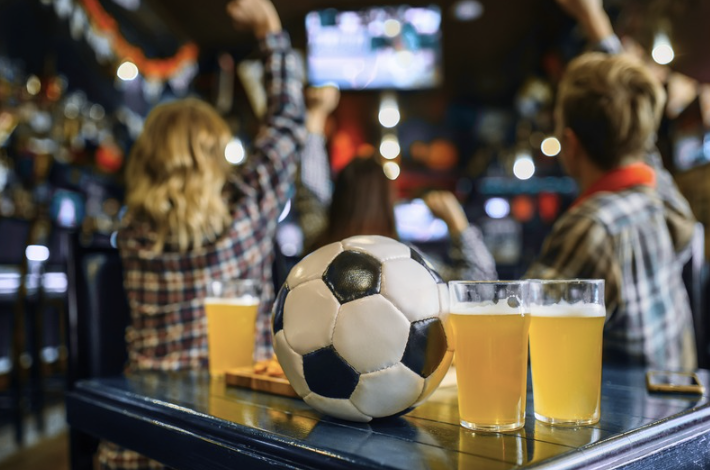
Friday afternoon I churned out a rough draft of this post. I cut my work day short so I could bike to a neighborhood sports bar in time for a 2pm kickoff. Spain won! ¡Olé! At the high top table sat two Americans and two Africans, one from Chicago, one from New Orleans, one from the Congo, one from Ivory Coast. Two of us rooted for Spain, two for Belgium. We joked and bantered the entire ninety minutes, trading stories of our upbringing, comparing notes on how soccer gets played and watched across the world. Strangers an hour before, and by the final whistle it did not feel that way.
Today is Sunday, the excitement of yesterday’s games past, a day of rest. This is when I actually sit down to write the second and third drafts, no ticking clock till kickoff. It is semifinals week, and the excitement is building again. Friday I was drafting in a hurry, in bullet points, trying to see how much I could get done before that 2pm game. Then I got mad at myself. I hadn't even thought to put the games on my calendar. A month ago I would not have called myself a true World Cup fan. Turns out I am one now, and so are half my clients.
It has been a glorious distraction. The excitement builds and we get hooked fast. It only happens once every four years. The whole world is watching, so surely we should be too. As teams get eliminated, our allegiances shift again, chasing whoever is still standing so the feeling doesn't have to end. One week it's Colombia, because my teammate's friend is dating a Colombian and they are the cutest couple. The next week it's Switzerland, purely for the chocolate. Sometimes the loyalty is political, we want the colonized to beat the colonizer, just this once.
Of course there's a neurobiological reason for this. The games build tension and release rushes of dopamine, over and over, for ninety minutes plus stoppage and overtime. And if it goes to penalty kicks, our bodies flood with adrenaline and cortisol too, heart racing, palms sweating, the same fight or flight response reserved for real danger, fired off over a shootout we're watching from a barstool. All of it feels good, even the fear. And there's a real difference between choosing to enjoy something and addiction, between deliberate choice and compulsion. One client shared that she felt lost on the days there was no game. What was she going to play in the background while she worked from home? She had started counting, and in the last month she had watched more soccer than in the previous two years of her life combined.
As someone who works very hard to manage my attention, I have no TV in my house. I know that to support my brain, I have to optimize the environment to better serve it. This means removing the distraction, creating obstacles to the temptation, more steps, making it more difficult. But of course I can keep checking my phone for the score. My son showed me how to find it on YouTube, and there's always my dive bar across the street, with a TV deep in the back behind the video poker machines, next to the jukebox.
In a session with the same client who felt lost without a game, we named what was actually happening. This wasn't really about soccer. It was another version of all or nothing thinking: wait for the day with no game, then work. Wait until after the match, then start. Later that day, I had a conversation with a friend from the Midwest suggesting that we visit the Badlands. Honestly, it’s not on my bucket list, but something he mentioned did pique my interest.
Mount Rush Less
The Crazy Horse Memorial. Indeed, crazy. It has been under construction since June 3, 1948, commissioned by Henry Standing Bear, an Oglala Lakota chief, in direct response to Mount Rushmore. He wanted the world to know that Native Americans had great heroes too, worthy of the same honor carved into the same hills. From the beginning, the family running the project refused government funding, even when it was offered, because they wanted the work to stay entirely their own, driven by passion rather than a check from Washington. Nearly eighty years later, there is still no official completion date. The face was finished in 1998. The hand and shoulder are projected for the mid 2030s. It is literally an example of chipping away over time to accomplish a monumental task, community funded, community driven, and entirely admirable in its refusal to be rushed.
This is the difference between slow and steady and all or nothing. Nobody at Crazy Horse is waiting for a day with no game to start working. They show up and chip away, a little at a time, day after day, decade after decade. The slow pace has arguably helped rather than hurt. As the technology caught up, the carving started moving faster, not slower. Patience bought them precision.
An old story, a modern surprise
European cathedrals took centuries to build this way too. Cologne took over six hundred years. Milan's Duomo took nearly five hundred seventy. So when La Sagrada Família in Barcelona finally, actually reached a completion milestone this month, I was surprised, then I wasn't. The central tower, the tallest one, reached its full height in February, and Pope Leo blessed it in June, one hundred years after Gaudí's death and one hundred forty four years after the first stone was laid.
Turns out it is basically the same story as Crazy Horse. Sagrada Família has never taken a euro of government money, not even from the Vatican. It was funded entirely by donations, by people who wanted to see it exist. Gaudí, who spent decades on it, was famously unbothered by how long it was taking. "My client is in no hurry," he liked to say, meaning God. Two projects, an ocean apart, both built without deadlines, without government money, without anyone rushing them, both turned into some of the most awe inspiring structures on earth.
How fascinating to notice what these two projects have in common. Each project connects to something greater than the people building it. Each one creates a genuine sense of belonging, not a borrowed one. Each is a community effort where everybody wins, not a competition where only one side walks away with the trophy. Each got built a little at a time, thoughtfully, intentionally, by people who knew exactly why it mattered to them.
Now the World Cup
The tournament we're all watching this month is a different animal entirely. The bid that won hosting rights projected eleven billion dollars in profit for FIFA, more than double the competing bid. Ticket prices that were capped around fifteen hundred dollars in the original bid documents were selling for over eight thousand by the time the tournament arrived, enough to trigger investigations by multiple state attorneys general. The revenue concentrates at the top. The costs, security, transit, infrastructure, get pushed down to host cities and taxpayers who never asked to be philanthropists. Built for speed, spectacle, and profit, on a strict four year deadline, the opposite of a mountain carved without a due date.
It does bring us together, briefly. The afternoon I sat at that high top with two strangers from three continents, arguing good naturedly over Belgium and Spain, trading stories of home, that connection was real. For ninety minutes we were unified, screaming at the same television, feeling like part of something bigger than our own to do list. But it is fleeting. The final whistle blows, and we go back to our actual differences, our actual conflicts, our actual wars, largely unchanged by the month we just spent feeling connected. It hands us the dopamine hit of belonging without asking anything of us, and it leaves just as fast as it arrived.
What we're actually chasing
We are prone to distraction, and underneath that distraction is something real: we want to feel a sense of belonging. We want to feel connected to something larger than ourselves. The World Cup does that. For ninety minutes at a time it gives us exactly that feeling. But it can also leave us feeling empty inside, a little inauthentic, once the high wears off and the connection was never really ours to keep.
When we pursue things that align with our core beliefs, things that feel true to us, we can work at them slowly and intentionally, and feel good about that too. It can still be serving something greater than ourselves. It can still connect us to a larger meaning, and give us fulfillment and belonging, the same craving the World Cup meets, just built to last. The all or nothing quick fix can be redirected toward something more meaningful, even if it takes far longer to accomplish.
How do we identify what is truly important to us, once the game is over and the noise dies down? How do we make a real difference in the world around us, not just a temporary, televised one? How do we build the kind of community where everybody wins, instead of one where a winner requires a loser? How do we do that work together, a little at a time, the way a mountain gets carved and a cathedral gets finished, without waiting for a day with no game to start?
How do we identify what is truly important to us?
How do we make a difference?
How do we build community where everyone wins?
How do we work together, a little at a time?
What can we chip away at today?
"Chipping Away" is a blog post by Adela Baker, ADHD coach and founder of Mind Coach, LLC in New Orleans. Written during the 2026 FIFA World Cup, it uses the tournament's dopamine-driven pull, along with the neuroscience of compulsion versus deliberate choice, as a lens for a much older question: how do we find belonging that lasts? Drawing a contrast between FIFA's profit-driven, deadline-bound model and two donation-funded, generations-long projects, the Crazy Horse Memorial and the newly completed Sagrada Família, the post explores how Turbo Thinkers® can redirect the same craving for connection and quick dopamine relief toward something slower, more intentional, and rooted in personal values. It closes with coaching questions on identifying what truly matters, building community where everyone wins, and chipping away at meaningful work a little at a time.
Read more about the difference between a fleeting "quick fix" and building things that are "built to last" in my blog post Fantasía Fina: Novelty vs. Maintenance.
Read more about the slow and steady approach in my blog post The Gift of Not Knowing: Why Beginner’s Mind Is a Turbo Thinker’s Secret Weapon.
Read more about curiosity over constant competition in my blog post Swimming Against the Current: Mindful Productivity.